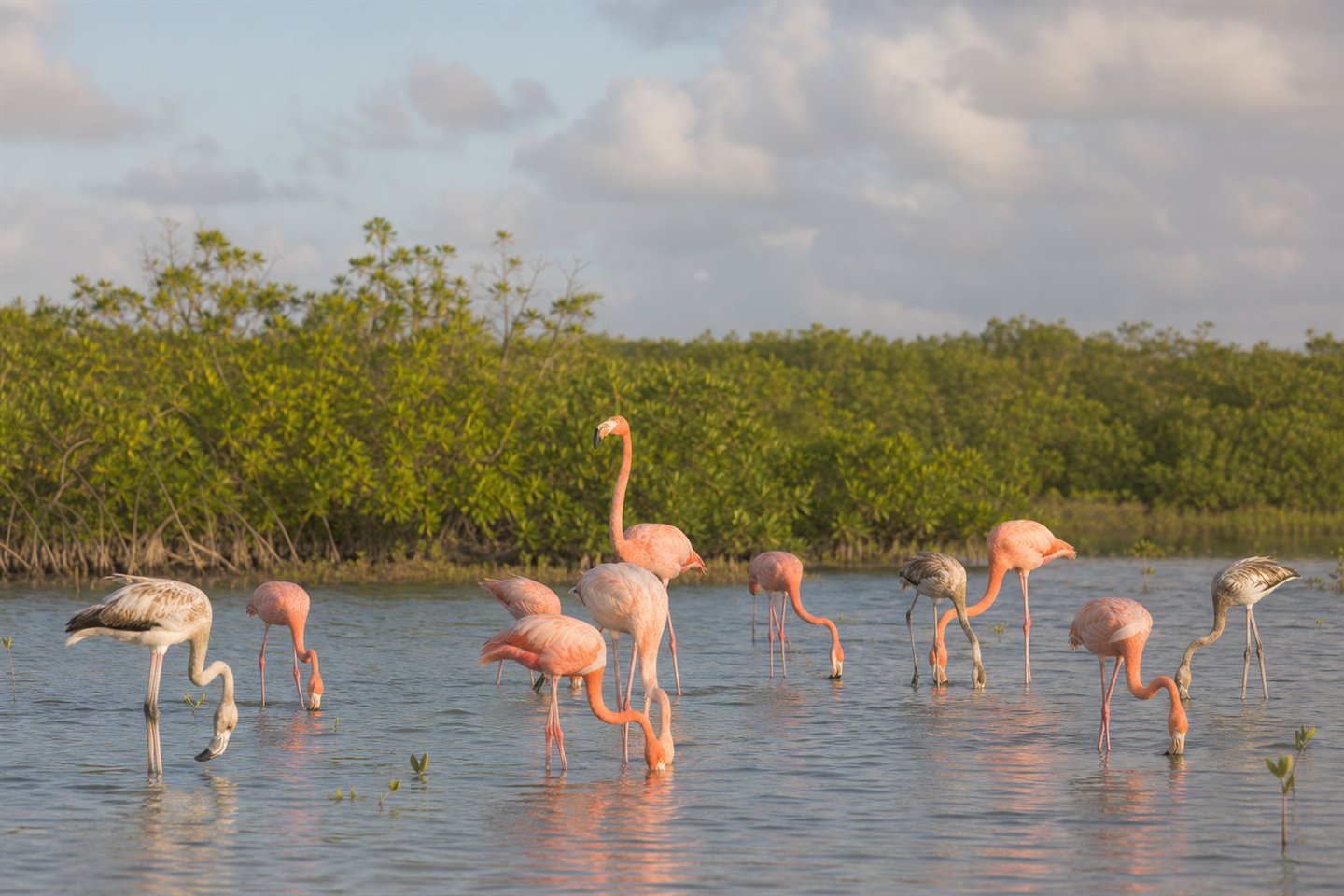
If one bird is strongly associated with the northern coast of Yucatan, it is the American flamingo (Phoenicopterus ruber). Visitors who arrive in Sisal looking for the beach may discover a very different landscape around the wetlands, mangroves and shallow waters surrounding the town.
Flamingo presence changes over time. These birds move among coastal areas according to water levels, food availability, season and environmental conditions. Some days may bring large groups, while at other times only a few birds, or none, are visible.
Where does their color come from?
Young flamingos have gray or whitish plumage. Their pink coloration develops gradually from carotenoid pigments in their diet. The pigments reach the birds through algae, small crustaceans and other aquatic organisms.
Their bill is adapted for filter feeding. With the head lowered into the water, they stir the bottom and separate small food particles through specialized structures in the bill and tongue. Water depth and salinity help determine which feeding areas are most favorable.
A network of wetlands
Flamingos should not be understood as permanent residents of one particular spot. They use a regional network of coastal lagoons, salt flats, wetlands and shallow waters around the Caribbean and Gulf of Mexico. Within this network, the Yucatan peninsula provides areas for feeding, resting and breeding.
This is also why a sighting can never be guaranteed. Finding flamingos depends on their natural movements and the conditions of the day. The experience is more meaningful when understood as wildlife observation rather than a scheduled attraction.
How to observe them respectfully
Tours with local guides can help visitors navigate permitted channels and observation areas without approaching too closely. Keeping distance, speaking quietly and avoiding sudden movements makes it possible to watch their behavior with less disturbance.
- Do not ask a guide to chase or surround birds for a photograph.
- Avoid music, shouting and other loud noises.
- Never feed flamingos or other wildlife.
- Use binoculars or a telephoto lens instead of moving closer.
- If the birds stop feeding or try to move away, increase the distance.
More than a beautiful image
Flamingos depend on functioning wetlands with suitable water, sufficient food and quiet resting areas. Their presence alone does not summarize the health of an entire ecosystem, but their movements and condition are closely connected with changes in lagoons, mangroves and feeding areas.
Protecting these environments also benefits fish, reptiles, crustaceans and many resident or migratory birds. The next time you see flamingos near Sisal, remember that you are watching an emblematic Caribbean species within a much larger natural system.